

It’s dangerous when politicians to enter the room with physicians and patients. That certainly applies to the many punitive and egregious measures states have adopted about reproductive and transgender rights. But another type of proposed legislation — this one a barely noticed item — caught my interest.
In short, H.B. 3615, introduced in the South Carolina legislature, would prohibit health care facilities from initiating discussions about “Do Not Resuscitate Orders” with patients and patient family members, with exceptions. At the moment, the bill is in the hands of the House of Representative’s Committee on Medical, Military, Public and Municipal Affairs, which is headed by a Republican legislator.
What?? If you are in the hospital being treated for a serious illness, or perhaps a life-limiting illness, isn’t it right, moral and in fact legal to learn about and understand all of your options? And if you cannot make decisions for yourself, shouldn’t your family be accorded the same? In short, yes. In fact, if you are on Medicare and have a discussion in your physician’s office about how you feel about Do Not Resuscitate (DNR) and other measures that you can build an advance care plan around, Medicare will compensate your physician for that discussion.
What on earth would prompt a legislator to introduce such a bill? The question nagged at me until I decided to call Rep. Annie McDaniel in South Carolina to ask her about it. McDaniel is a Black woman Democrat in a state with a Republican supermajority in both its House of Representatives and its Senate.
We talked logistics first. Rep. McDaniel has no idea about whether or not her bill will pass, but she mused that since the majority party is all about pro-life, perhaps it will support this legislation that addresses end of life issues, not just life’s beginnings.
When I asked her what prompted her to draft this bill, the answer was less surprising and more nuanced than I had initially thought. It was born of unsatisfying communications in the hospital where her mother was being treated for a serious illness, when it seemed like every few hours, McDaniel said, someone would come in to ask her mother to sign a DNR statement. It seemed cold and insensitive, when what the family really needed to know was how her mother had gotten to the state she was in, the range of treatment options, and what her prognosis was – all communicated by a person with compassion.
Beyond Just the DNR Question
So it wasn’t really about the idea of a DNR in itself; at heart it was about the often poor and fragmented communications too many of us have had to contend with in a hospital setting. Even under the best of circumstances, it’s not unusual to feel confused and powerless, or to struggle to learn how and when to communicate with medical staff in charge with your or your loved one’s treatment.
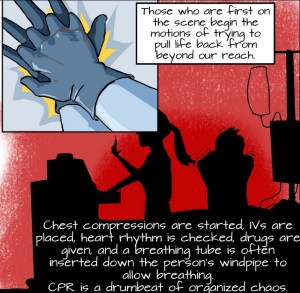
Is the answer to that much broader issue a simple ban on discussing DNR orders? No, especially if no one has taken the time to explain what that order means, what resuscitation truly involves, and what other types of interventions might be necessary to sustain a person’s life.
The bill may or may not pass. I tried to reach Syllest Davis, chair of the South Carolina Committee on Medical, Military, Public and Municipal Affairs, to get her insights, but have not heard back from her. Absent a DNR in place, will lawmakers worry that it will simply cost too much to keep people alive through mechanical means and prove too much of a burden for the health care system, for example? What concerns me more about the bill, though, is the possibility of its taking on a life of its own in the online ether, somehow prompting other states to follow suit.
If that happens, it will become even more important for us to have had advance care discussions in advance of a possible hospital stay; put our ideas and preferences in writing and absolutely make sure to tell our loved ones what we want and what we don’t want in the event we cannot speak for ourselves.
This is just one of many health care and medical issues that are sure to vex us in 2025. But in the quiet as 2024 winds down, I want to wish you all a wonderful holiday season and a happy and healthy new year.





 I’m sure you’re as sad as I am, on hearing the news about Jeopardy’s Alex Trebek’s Stage IV pancreatic cancer diagnosis. Can we even imagine Jeopardy with someone else? Well, apparently, Alex can’t either because he’s vowed to “fight this” and “beat it,” and make good on the remaining three years of his contract.
 Last Comforts