Tag Archives: elder care

Bridging the Gap Between Generations

Since 2018, I’ve been deeply involved with Age Friendly Teaneck’s (www.agefriendlyteaneck.org)  four-week summer internship program for high school students, known as Exploring Careers in Aging. The program has two main goals: to give students the opportunity to learn about a variety of careers in aging (ranging from health care to architecture and construction) that they might not have been aware of; and to combat the many stereotypes about aging that are still far too prevalent in our culture. We encourage intergenerational connections with visits to a variety of venues where interns and elders can find common ground; and we aim to combat the isolation and loneliness that can arise in part because of the culture’s misconceptions about aging. 

            One of my roles throughout the internship is showing films that center on some aspect of aging, and conducting discussions with the students after each screening. One of my favorite films – and the one we show first – is “Lives Well Lived,” a documentary by filmmaker Sky Bergman. I love this film because in the process of interviewing 75 people between the ages of 75 and 100, we get to know so many women and men living active, productive and meaningful lives, talking about what, exactly, makes for a life well lived. They are all positive, they have a sense of purpose in their lives, and they are clearly resilient. It is inspirational. And it offers plenty of food for thought for our interns.

            Sky embarked on the documentary by interviewing her then-99-year-old grandmother, to show how active and engaged in the world she was: cooking, socializing, going to the gym and reflecting on her life and what has made it so meaningful. Sky then broadened her lens to include many other elders to learn about their lives too. These were not people who had lived a life free of hardship or heartache.

Many recalled the traumas of World War II: one being separated from a parent in fleeing a country; one being forced to live in an internment camp (and becoming a widow with two young children as her husband fought for this country), for example; the challenge of starting a new life in the U.S.  Others were active in the civil rights movement; or 

overcame hurdles to complete their education years after early education was interrupted. And yet their positivity remained intact. And they had plenty of great advice for all of us.

Creating a Movement

           I admire Sky greatly because her own story didn’t end after she had done this documentary. It has evolved into a movement that connects elders and members of younger generations, to share their experiences and outlooks, which has enriched the participants. And she is determined to encourage others to find ways to bridge the gap between generations and to understand “the transformative power of listening to and learning from each other,” Sky says. “Ageism diminishes when generations connect.”

            And so she has published a book, “Lives Well Lived: Generations — Resilience, Positivity and Purpose at Every Age” to spread that message. The book is divided into several sections that roughly mirror Sky’s own evolution: why she decided to do her documentary; glimpses of many of the people she features in the documentary, quoting their observations; and how the movement to connect generations has grown. Of great value are the roughly three dozen chapters written by intergenerational program directors from all across the country – with links to their websites – about what they do, how they do it and what the benefits have been.

Programs range from the social (such as sponsoring intergenerational dinners) to such pressing issues as housing affordability and voter registration. The book also includes considerable guidance for those who are interested in either screening the film and starting a discussion about it; or starting an intergenerational program of their own. There is more guidance on the website www.skybergmanproductions.com. The book is available on Amazon at  https://a.co/d/aBvvbaG

            Two years ago, one of our Age Friendly Teaneck interns was so taken with the film that she decided to do her end-of-internship project about a few people in our town who had embarked on their second chapters. And we also arranged for her to interview Sky by phone. I can tell you that it was hard to tell who was more enthusiastic about this interview, our intern or Sky herself. Which to me proved the essential wisdom of this intergenerational movement. 

AMAZON: bit.ly/LWLAmazon

iTUNES: apple.co/2YpODcI

PBS Passport: pbs.org/show/lives-well-lived

KANOPY: kanopy.com/en/product/12391561

A Troubling Bill in South Carolina that Would Suppress Medical Guidance

Screenshot

            It’s dangerous when politicians to enter the room with physicians and patients. That certainly applies to the many punitive and egregious measures states have adopted about reproductive and transgender rights.  But another type of proposed legislation — this one a barely noticed item — caught my interest.

            In short, H.B. 3615, introduced in the South Carolina legislature, would prohibit health care facilities from initiating discussions about “Do Not Resuscitate Orders” with patients and patient family members, with exceptions. At the moment, the bill is in the hands of the House of Representative’s Committee on Medical, Military, Public and Municipal Affairs, which is headed by a Republican legislator.

            What?? If you are in the hospital being treated for a serious illness, or perhaps a life-limiting illness, isn’t it right, moral and in fact legal to learn about and understand all of your options? And if you cannot make decisions for yourself, shouldn’t your family be accorded the same? In short, yes. In fact, if you are on Medicare and have a discussion in your physician’s office about how you feel about Do Not Resuscitate (DNR) and other measures that you can build an advance care plan around, Medicare will compensate your physician for that discussion.

            What on earth would prompt a legislator to introduce such a bill? The question nagged at me until I decided to call Rep. Annie McDaniel in South Carolina to ask her about it.  McDaniel is a Black woman Democrat in a state with a Republican supermajority in both its House of Representatives and its Senate. 

            We talked logistics first. Rep. McDaniel has no idea about whether or not her bill will pass, but she mused that since the majority party is all about pro-life, perhaps it will support this legislation that addresses end of life issues, not just life’s beginnings. 

            When I asked her what prompted her to draft this bill, the answer was less surprising and more nuanced than I had initially thought. It was born of unsatisfying communications in the hospital where her mother was being treated for a serious illness, when it seemed like every few hours, McDaniel said, someone would come in to ask her mother to sign a DNR statement. It seemed cold and insensitive, when what the family really needed to know was how her mother had gotten to the state she was in, the range of treatment options, and what her prognosis was – all communicated by a person with compassion. 

Beyond Just the DNR Question 

            So it wasn’t really about the idea of a DNR in itself; at heart it was about the often poor and fragmented communications too many of us have had to contend with in a hospital setting. Even under the best of circumstances, it’s not unusual to feel confused and powerless, or to struggle to learn how and when to communicate with medical staff in charge with your or your  loved one’s treatment.

Is the answer to that much broader issue a simple ban on discussing DNR orders? No, especially if no one has taken the time to explain what that order means, what resuscitation truly involves, and what other types of interventions might be necessary to sustain a person’s life.

            The bill may or may not pass. I tried to reach Syllest Davis, chair of the South Carolina Committee on Medical, Military, Public and Municipal Affairs, to get her insights, but have not heard back from her. Absent a DNR in place, will lawmakers worry that it will simply cost too much to keep people alive through mechanical means and prove too much of a burden for the health care system, for example? What concerns me more about the bill, though, is the possibility of its taking on a life of its own in the online ether, somehow prompting other states to follow suit. 

If that happens, it will become even more important for us to have had advance care discussions in advance of a possible hospital stay; put our ideas and preferences in writing and absolutely make sure to tell our loved ones what we want and what we don’t want in the event we cannot speak for ourselves. 

This is just one of many health care and medical issues that are sure to vex us in 2025. But in the quiet as 2024 winds down, I want to wish you all a wonderful holiday season and  a happy and healthy new year. 

Why It Matters to Talk About Values with Dementia Patients

As relieved as we are about finally seeing the awful year 2020 in the rearview mirror, I’d say that one useful thing the pandemic has given us is an in-your-face awareness of mortality and the gravity of serious illness. And it’s given us permission to talk about it more freely.

But what about loved ones who may be newly diagnosed with dementia? As caregivers know only too well, dementia progresses to the point where ultimately those afflicted may not be able to think clearly, reason well or speak. They become increasingly dependent on others for their care. So, to honor these loved ones, to support them in the way they’d want to care for themselves and to make sure that medical professionals understand the best way to respect what matters to them, it is vital to ask the questions regarding future care when loved ones are still able to articulate their answers.

How do you even begin to discuss these life-and-death issues? Especially if loved ones are anxious about their health and their future, or resistant to the idea that anything is wrong at all? Before trying to talk about the pros and cons of specifics of what I’d call “the Big Three” — CPR, mechanical ventilation and feeding tubes – it’s important to talk about values first. One great source of advice for this is the <a href="http://(https://theconversationproject.org/wp-content/uploads/2017/02/ConversationProject-StarterKit-Alzheimers-English.pdf) which offers a “starter kit” for those caring for people with dementia, at various stages.

The starter kit stresses the importance of beginning with exploring what matters to loved ones, what they fear, what kind of setting they envision if they were at the end of life, how involved they want to be in their medical care and who they’d like to have around them. It also emphasizes the importance of keeping the talk simple. Its questions are clear and straightforward. Finally, it stresses how important it is that you convey that this process is an act of love and that you will be there to support your loved one, no matter what.

Understanding loved ones’ values provides the framework for future decisions as dementia progresses. Advance directives, and health care proxies (those who will be responsible for speaking for loved ones) should reflect these values.

Some Points to Consider About Artificial Nutrition

Of the “Big Three,” let’s focus here just on artificial nutrition (feeding tubes): Sadly, people in the final stages of dementia may not remember how to eat, or be able to chew and swallow. Artificial nutrition is one solution to this issue, but it is not without its own problems According to the American Academy of Hospice and Palliative Medicine, for patients near the end of life, artificial nutrition and hydration is unlikely to prolong life and can potentially lead to medical complications and increased suffering. How? For starters, it makes people feel bloated, nauseated, and/or develop diarrhea.

Experts say it’s better to offer a little food or something to drink, and if your loved one wants it, even a minimal amount, fine. If not, don’t force it. There are other ways to continue to nourish your loved one, if food and fluids are no longer an option.

A useful template of an advance directive for people with dementia, published by End of Life Washington, addresses the feeding-by-hand issue. It states, “If I accept food and drink (comfort feeding) when they’re offered to me, I want them. I request that oral food and fluids be stopped if, because of dementia, any of the following conditions occur:

• I appear to be indifferent to being fed.
• I no longer appear to desire to eat or drink.
• I do not willingly open my mouth
• I turn my head away or try to avoid being fed or given fluids in any other way.
• I spit out food or fluids.
• I begin a pattern of coughing, gagging or choking on or aspirating (inhaling) food or fluids.
• The negative medical consequences of symptoms of continued feeding and drinking, as determined by a qualified medical provider, outweigh the benefits.”

No doubt this is all a lot of food for thought (pardon the pun) for caregivers and loved ones alike. But it’s the hard work of discussing and documenting loved ones’ values and wishes that will be the foundation for the compassionate and appropriate care that loved ones deserve later on in the course of illness.

Wishing everyone a safe, healthy and happy 2021.

Planning Ahead in the Time of Covid-19

One way the coronavirus pandemic has upended what we think of as normal life is how we think about mortality.

How? First, while there’s still so much we don’t know about the virus, what’s clear is that it can, with startling rapidity, do fatal damage even to otherwise-healthy people. It might be a matter of just days or weeks between the time a person first experiences symptoms and the time that person becomes critically ill.

Second, the very sick patients in assisted living, skilled nursing facilities, or in hospital intensive care units must bear the burden of illness alone; visits from loved ones are prohibited. That means a loss of the comfort of being together through a harrowing ordeal.

Third, patients on ventilators must be sedated, and are unable to speak to their loved ones. So there’s no way to have any kind of conversations, much less talks about goals of medical care. Nor can nurses or doctors do what palliative care and hospice physicians have always done best, which is to listen to patients about their lives, their hopes and fears, and to assure them with their very presence that the patients are well cared for.

Fourth, because we cannot gather in groups, we cannot depend on the comfort of family and friends and the time-honored rituals of grieving at funerals or memorial services. Much has been written about the concept of complicated grief, and this pandemic will certainly require a whole new chapter.

This is the horrifying reality that we see and read about, day after day. So it seems to me that this National Healthcare Decisions Day takes on more of a sense of immediacy than it may have in the past. That is, now is the time to think about what kind of care we’d want if we could not speak for ourselves; discuss it with family; get it in writing; and designate a health care proxy.

Of course, it is still true that it’s impossible to decide what kind of treatment you’d want, or not want, if you don’t understand what these treatments entail.

Let’s talk about ventilation, as an example. The best article I’ve read about the why’s and how’s of ventilation is one by Daniela Lamas, MD, a critical care physician at Brigham and Women’s Hospital in Boston and I urge you to read it.

Before Covid-19, my advance care plan said “no thanks” to it. But it seems key to saving the lives of some extremely ill Covid-19 patients and I would not refuse it if I had the virus.

What Dr. Lamas does not mention, though, is that typical time on the ventilator has been longer, on average (up to two weeks or even more) for Covid-19 patients than it has been in conventional uses. That in itself can lead to possible lung damage as well as emotional and psychological issues for recovering patients. Nor does she mention the sad fact that being on a ventilator does not guarantee survival. While it’s still too early to say what percentage of Covid-19 patients do survive ventilation, a large study on that, done by the Intensive Care National Audit & Research Centre in London, found that just 33 out of 98 ventilated patients in the U.K were discharged alive.

So there’s plenty to think about on this National Healthcare Decisions Day. But, hey, we’re home, we’ve got some time on our hands. Pour yourself a glass of wine, or something stronger, and talk it over. And if you need a little guidance getting started, here’s a great resource.

For the Skills We Never Learned in School

Did you know that today 20 million family caregivers regularly perform a range of tasks for family members or friends? That’s according to AARP. The fact is, many of us are – or will become – caregivers, and that most of us have never been trained to do some of the often complex tasks that will be needed.

Fortunately, there’s more and more online help available to caregivers. So, in honor of National Family Caregivers Month, here’s my latest blog post for Sixty and Me about some of the instructional videos available now:

‘Elderhood’: A Necessary Look at Embracing Aging in All its Stages

I wonder if Madonna, 60, thinks of herself as old.

I’m guessing probably not, but maybe she should. Think of how much she might contribute to the discussion about what it means to age, to grow older well, and how we can facilitate that for all of us, not just for a privileged few.

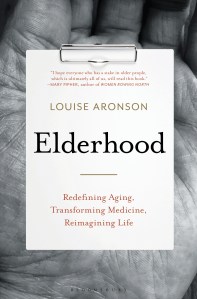
This thought might never have crossed my mind except for having read Louise Aronson’s extraordinary new book, “Elderhood: Redefining Aging, Transforming Medicine, Reimagining Life,” and having the opportunity to interview her about it. Aronson is a geriatrician and professor of geriatrics at the University of California San Francisco.

In the book, an amalgam of facts, patient stories, tales of Aronson’s own education and medical experience — as well as references to history, anthropology, literature and scientific studies — combine to shine a light on the necessity to rethink aging itself. Bonus: reading it also provides the great pleasure of following the path of a unique and invaluable mind and heart.

In some ways the book is an indictment of our medical system, which recognizes that chronic illness and aging are a major health challenge, but often treats those who experience it or the specialists who treat it as second class citizens. And she has a number of recommendations for changing the system. Among the many reasons why the need for change is so compelling: People who are 65 or older represent 16 percent of the U.S. population, but nearly 40 percent of hospitalized adults; with a few notable exceptions, hospitals as they are designed and operated currently present a great many challenges for elders.

“Elderhood” is also a road map for those of us who are aging to tap back into our boomer activist genes and insist on better care as we go forward, not only from the health care system, but also from policymakers who have a big impact on how that care is provided and paid for. As for ourselves individually, it’s time to discard the clichés and stereotypes of aging we may have internalized over the years.

“Elderhood is life’s third and final act; what it looks like is up to us,” Aronson writes. “This third act is not a repeat of the first or second. More often it is in life what it is in drama: the site of our story’s climax, denouement and resolution.”

The book dispels a number of myths about what aging looks like. “Old age is only partially determined by biology. It’s long, varied, relative and relational,” she writes, noting that “a good part of the suffering in old age is manufactured by our policies and attitudes.”

Owning Our Elderhood, in All Its Substages

Elderhood comprises a number of substages and in Aronson’s view we need better language for those substages. As an example: at 55, she has taken to referring to herself as old when she teaches her medical students at UCSF (who, she said, amused, most likely consider her “old” anyway).

“The more we own it, the better. We reform it,” she said. Much as the LGBTQ community has taken back the word “queer” and succeeded in taking the awful sting out of it, we can “reclaim, create or repurpose simple words to redefine themselves and their place in society,” she writes.

Aronson stresses that the numbers of elders who find satisfaction and purpose in their lives and consider their health excellent – despite having to contend with a variety of ills – are legion. Studies have shown, for example, that anxiety rates fall around 60. In their 80s, she has found, for the most part people are quite satisfied, more so than in their 40s and 50s.

“Adaptability is a huge defining characteristic of elderhood,” she told me.

In her elderhood clinic at the University of California San Francisco, Aronson treats people ranging in age from 60 to 102. (Fun fact: The World Health Organization, among others, defines people aged 60 and up as old.) So, she points out, there are at least two generations within this group.

“It’s time for elderhood to take its rightful place alongside childhood and adulthood,” she writes. That includes the “young-old” and the “old-old” and all the stages in between, under the umbrella of elderhood.

Aronson explained that in her clinic, dealing with the “whole human being” is of first and foremost importance. She focuses on functional status because “that’s a better predictor of whether [patients] will wind up in the hospital or not.” Together, she and her patients discuss preferences and goals – not just medical, but goals of life. She also wants to know about “who’s in their world?” In other words, how does the person live, who is available to be supportive, what obstacles or barriers lie in the path to a better quality of life and how does the person actually feel about aging. “That impacts recovery,” she said. The clinic practices what she calls the four “P’s”: prevention, purpose, priorities and perspective.

“Failing to fully acknowledge the ongoing human development and diversity of older Americans is bad medicine and flawed public health,” she says, noting that “we can only make aging good if we make it good for all of us.”

I could go on quoting Aronson, but I won’t. Instead, I encourage you to read it to discover the many gems to be found.

Maybe Madonna should read it too.

A Senior’s Guide to Navigating Medicare for Mental Health Treatment

(Note: This is a guest blog, from Teresa Greenhill, co-creator of MentalHealthForSeniors.com, a website dedicated to providing information on physical and mental fitness.)

Mental health is a serious issue among seniors. In fact, depression affects about 5% of people over 65 as well as up to 13.5% of older adults who require home healthcare. While depression is a common problem, it’s not a normal side effect of growing older. Depression should not be something we simply endure as part of the aging process. If you’re experiencing depression, keep reading to find out how Medicare can help you cover your treatment and support your mental health in the long run.

Mental Health Services Covered by Original Medicare

Original Medicare—also called Medicare Parts A and B—covers a variety of mental health services. Medicare Part A covers the costs of mental health care for hospital inpatients, including therapy and medications administered in a hospital setting. When it comes to outpatient mental health services, Medicare Part B covers one depression screening every year. In addition, it covers psychiatric evaluations, diagnostic tests, medication management, family counseling, and therapy with licensed mental health professionals such as psychiatrists, psychologists, and social workers. However, seniors using these services should be aware of deductibles and copays. After you reach the deductible for Medicare Part B, you will have to pay 20% of the cost for each mental health service.

Unfortunately, Original Medicare alone does not cover prescription drugs or other essential services that can support your mental health treatment. This is why many seniors opt for a Medicare Advantage plan. Medicare Advantage plans offer all the same benefits included in Original Medicare, plus coverage for services like vision, dental, hearing and prescription drugs to help improve your quality of life.

Finding the Right Medicare Plan

There are over 3,700 Medicare Advantage plans available across the United States, so how are you supposed to choose one? Start by making a list of services that you need covered. For example, you may need prescription drug coverage if you’re prescribed medications to treat your depression. If you have vision or hearing problems, make sure your plan covers these services as well—taking care of your physical health is crucial to good mental health. Untreated hearing loss, for instance, can lead to cognitive impairment! Additionally, many Medicare Advantage plans have in-home support services which can significantly improve quality of life for people facing mobility limitations.

Medicare Advantage plans that provide access to wellness programs may also be a good choice for people with depression. Research from McMaster University a public research university in Hamilton, Ontario, Canada, shows that staying active plays an important role in treating and preventing depression. Additionally, any senior with Medicare can also take advantage of a free annual wellness visit. During this visit, seniors can discuss prevention strategies with their doctor and develop a personalized plan for avoiding mental illness in the future.

Ensure Your Mental Health Provider Accepts Medicare

Since many psychiatrists opt out of Medicare, you may have trouble finding a mental health professional that accepts your health coverage. Fortunately, U.S. News recommends a few steps patients can take to find the mental health care they need. Start by talking to your primary care provider about your mental health concerns. Your doctor may be able to prescribe medication for your condition and refer you to professionals who they know accept Medicare. If you enroll in a Medicare Advantage plan, ask for a list of covered providers. For seniors who live in rural communities, telepsychiatry is a superior option to forgoing mental health care altogether. This service may be covered by Medicare, depending on where you live.

Is Your Mental Health Service Recognized?

On the other hand, you also need to ensure that your Medicare plan recognizes the mental health services you intend to use. CMS (the Centers for Medicaid and Medicare) recognizes mental health care provided by clinical psychologists, clinical social workers, clinical nurse specialists, psychiatrists, physicians assistants, nurse practitioners, and general practitioners. Non-medical doctors—like social workers and psychologists—must be Medicare-certified. Also, ensure your mental health care provider accepts Medicare’s approved amount for the services they’re providing to you.

Along the same lines, make sure that your Medicare plan will cover your prescription drugs. If you opt to stick with Original Medicare, you can add a prescription drug plan with Medicare Part D. Alternatively, you can choose a Medicare Advantage plan that includes drug coverage—most plans do. Either way, be sure to choose a drug plan that covers your prescriptions. If you cannot find a plan that covers all of your medication, consider choosing a plan that covers your most expensive drugs. It’s also important to check that your plan covers the pharmacy that you would like to get your medications from.

Depression is a serious problem that can accelerate aging and exacerbate age-related physical issues. Fortunately, seniors have several avenues for treatment. And, thanks to Medicare, you don’t have to spend a fortune to receive treatment for depression or any other mental health problems. Don’t hesitate to seek the treatment you need now.

My “Comfy” Awards for Media Excellence

Photo: Netflix

Welcome to the new year!

We are now in the midst of the 2019 film awards season, after the kickoff of the always amusing and entertaining Golden Globes. It reminds me that for some time, I’ve longed (in vain) for some kind of media awards event for accurate portrayals about late life. But to whom would those awards go? Alas, few recent films and TV programs might qualify.in late life, frailty, illness, death, loss and grieving don’t translate into blockbuster ticket sales.

But in the past year I’ve found a few standouts, mostly online, that deserve recognition. So in the spirit of the season, let’s call it the “Comfy Awards,” and I’m awarding “Comfys” to:

BoJack Horseman, “Free Churros,” Season 5, Episode 6, on Netflix

I should tell you that I feel that animated films and television programs can have more artistry, humanity and complex storytelling than many conventional live-action films. I’m a huge fan of the Toy Story films, Inside Out and most recently, the brilliant Isle of Dogs, for example. I’m also a huge fan of Bob’s Burgers on TV.

But right now BoJack Horseman is probably my favorite. This Netflix series chronicles the “Hollywoo” (that’s what Hollywood is called here) life of BoJack Horseman, a self-loathing and depressed former TV sitcom star, voiced by the actor Will Arnett. The premise of this world is that a dizzying variety of anthropomorphic creatures interact easily and regularly with human beings. BoJack’s agent, for example, is a cat, Princess Caroline, voiced by Amy Sedaris. The show is by turns hilarious, bitingly satiric, poignant and occasionally moving.

“Free Churros” is a stunning example of the latter. It consists of a 20-minute monologue by BoJack, who is delivering a eulogy to his mother. It is more of a stream-of-consciousness and it artfully suggests why BoJack is as self-involved, troubled and self-destructive as he is.

This is what struck me: Loss and grief are so much more complicated for those who have had strained or stormy relationships with their parents. There’s so much unfinished business. So much anger and resentment on top of the heartache of feeling a void that will never be filled. BoJack clearly had a fraught relationship with his mother (and an even more difficult relationship with his father). This episode beautifully captures all of pain and ambivalence about losing a parent in these circumstances. And still manages to end with a very clever joke.


“What Doctors Know About CPR,” Topic (online magazine)

I think it’s hard to prepare an advance directive if you don’t know precisely what some measures – like cardiopulmonary resuscitation (CPR) – really entail. Most of us have a general idea, probably from watching heroic and often extremely successful CPR episodes on our favorite medical TV shows. And using that as our guide, we might reasonably think, why not opt for that? There are plenty of reasons why not, in fact.

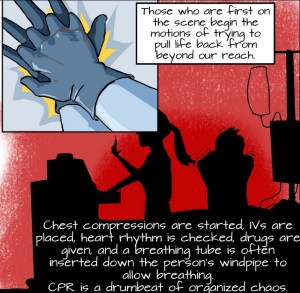
But it’s one thing to be told, or to read, about the risks and dangers of CPR; it’s quite another to see a graphic representation of what the process and its more often than not ill effects are. For that, we thank Dr. Nathan Gray, a palliative care physician at Duke University School of Medicine, who wrote and illustrated a graphic piece about the realities of CPR for Topic, an online magazine.

“CPR begins when a heart stops, the last domino to fall on the cascade toward death,” Dr. Gray writes. He illustrates a Code Blue being called, the mechanics and impersonality of the process and the statistics showing how few people actually survive intact.

“Until you witness it in person it can be hard to capture the inhumanity of our medical routine,” he writes. He urges the medical community to not let technology interfere with its humanity.

The piece is essential reading, and undoubtedly I will be using it in future talks about advance care planning.

Time Goes By blog, Ronni Bennett

Ronni Bennett has been writing her blog Time Goes By all about aging, for some time. But I didn’t discover it until several months ago when Kaiser Health News wrote a story about her.

Last fall, Bennett’s doctors told her that her pancreatic cancer had metastasized to her lungs and her peritoneum (which lines the cavity of the abdomen) and that there were treatment options but no cure for her condition. Now, if I’d been given this news, my first inclination would probably have been to hide under the covers in bed. Bennett’s inclination, though, was to write about it. And to keep writing, because for her that was a way of better understanding herself. Her hope was to approach the last chapter of her life “alert, aware and lucid,” she said.

“There’s very little about dying from the point of view of someone who’s living that experience,” she told Kaiser Health News. “This is one of the very big deals of aging and, absolutely, I’ll keep writing about this as long as I want to or can.”

Reading Bennett is, in fact, like having a great talk with a good friend. She is great company, amusing, touching and honest above all. About what she calls her terrors. About the ridiculous moments (she needs a new heater and thinks, Really? Now?) and the transcendent moments (a carefully guided psilocybin trip that she says has given her a greater sense about life and death). She has a large, avid readership and her honesty has made it possible for readers to share their stories, too. She also posts “The Alex and Ronni Show” — videos of her Skyped conversations with her ex-husband.

Most recently, she wrote: “However short or long my remaining days may be, it is a great gift I have received, knowing my death is near. It led to what I think is the most important question in the circumstance: what do you want to do with the time that remains?”

That’s a question we all need to think about. So, I’m awarding a “Comfy” to Ronni Bennett for the great service she is doing for all of us.

Do you have any suggestions for “Comfy” awards? I’d love to hear about them!